Disappearance of Ralph Paton
The Murder of Roger AckroydRalph Paton’s disappearance is the investigation’s most conspicuous gap: he leaves an inn on the night Roger Ackroyd is murdered and is not seen again, while reports place him near Fernly Park shortly before the crime. The resulting suspicion gives the police a coherent version of events, but not the truth of Ralph’s whereabouts. Hercule Poirot ultimately finds him in a nursing home near Cranchester, where Dr. James Sheppard had hidden him under another name.
Background and the missing man
The disappearance takes shape against the gossip and limited information of King’s Abbot, a village where, as Dr. James Sheppard observes, recreation can be summed up as gossip. Its residents are quick to turn fragments into theories, yet not every channel of local knowledge is reliable: even Caroline’s efforts to learn about the foreign stranger at The Larches have yielded little beyond his name and interest in vegetable marrows. In that close-knit setting, a missing person is at once a practical problem and a story for others to construct.
Flora Ackroyd tells Sheppard that she went to the inn after hearing from the servants that Ralph was staying there. She had not known he was in King’s Abbot and says she was astounded to discover it. At the inn, she was told that Ralph had gone out at about nine the previous evening and never returned. She offers possible explanations, including that he might have gone anywhere or returned to London; Sheppard points to the luggage he left behind as a difficulty for that account. Her visit confirms how little even someone close to Ralph can explain about his sudden absence.
Poirot insists that Ralph’s being missing under circumstances requiring explanation is a grave matter, while allowing that it may still admit of a simple explanation. That qualification matters: the disappearance is evidence, but it does not by itself establish guilt or even disclose Ralph’s destination. The investigators have to distinguish what is known—his absence—from what the circumstances merely encourage them to infer.
The case against Ralph
The police assemble details that make Ralph appear connected to the murder. Inspector Raglan says Ralph left just before nine, was seen in the neighbourhood of Fernly Park at about half past nine, and had not been seen since. He also cites Ralph’s serious money difficulties and a pair of his rubber-studded shoes, one of two almost identical pairs, which he intends to compare with footprints at Fernly Park. The shoes and the financial trouble give the disappearance the look of motive reinforced by physical evidence, though neither establishes what happened to Ralph after he left the inn.
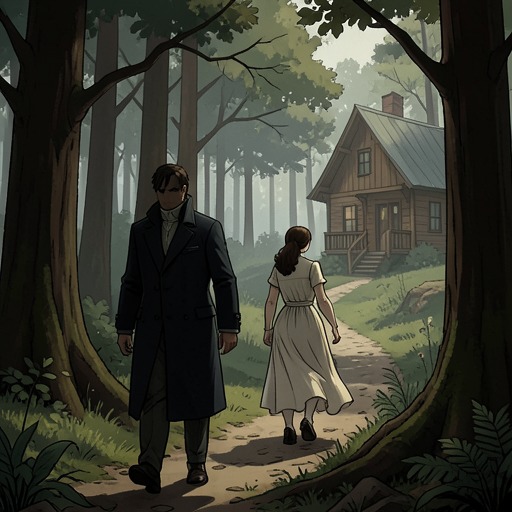
A lodge woman, Mary Black, supplies a more precise sighting. As she pulled the curtains, she says she saw Ralph pass through the gate at twenty-five past nine and hurry towards the house before turning onto the path that served as a shortcut to the terrace. Inspector Raglan combines that account with the report that Geoffrey Raymond heard someone asking Roger for money and Roger refusing. From those separate details, he builds a sequence: Ralph leaves by the study window, walks along the terrace, enters through an open drawing-room window, takes the dagger from the silver table, and returns to the study to attack Roger. Raglan’s reconstruction makes Ralph’s movements appear to fit the crime, but it is a theory assembled from sightings, timings, and assumptions rather than a witnessed account of the murder.
The village’s talk also keeps blackmail in circulation. When Davis raises the subject, Sheppard says that if Parker heard anything about blackmail, he must have been listening outside the door with his ear against the keyhole. Later, Colonel Carter tells Sheppard he has heard blackmail mentioned and speculates that a woman is involved. These remarks illustrate how suspicion travels through the household and village, but they do not explain Ralph’s whereabouts. The disappearance becomes entangled with multiple circulating accounts, each of which risks substituting a plausible story for established fact.
Concealment and discovery
The decisive explanation comes when Poirot returns to Sheppard’s culpable conduct. Sheppard had agreed to help Ralph and succeeded in keeping him from the police. Asked where he hid him, Poirot explains the reasoning that led him to Cranchester: a hotel seemed unsuitable, as did lodgings, while a nursing home offered a place close at hand where Ralph could be concealed. Poirot tested that possibility by inventing a nephew with mental trouble and asking Caroline Sheppard for the names of suitable homes. She gave him two near Cranchester to which her brother had sent patients.
Poirot’s inquiries then located a patient whom Sheppard had personally brought to one of those homes early on Saturday morning. The patient was registered under another name, but Poirot identified him as Ralph. After the necessary formalities, Poirot brought Ralph away; he had arrived at Poirot’s house in the early hours of the preceding morning. The discovery reverses the apparent logic of the case: Ralph had not simply vanished beyond reach, and Sheppard’s professional connection to a nursing home had enabled him to conceal the man in a place that could pass unnoticed as part of ordinary medical work.
The method of discovery also exposes the limits of the local information network. Caroline’s knowledge of nearby nursing homes, offered without knowing what her brother intended to hide, gives Poirot a route to the concealed patient. The same village habit of sharing information that fuels speculation can therefore yield a precise lead when Poirot tests a possibility against concrete circumstances. His success depends not on accepting the most vivid story about Ralph’s flight, but on asking where Sheppard would have been able to conceal him.
Narrative and investigative significance
Ralph’s disappearance works on two levels. Within the investigation, his absence leaves the police with a suspect whose financial difficulties, shoes, and reported movements seem to align with the crime. In the account as Poirot reconstructs it, however, the missing man is concealed by Sheppard, and the disappearance cannot be understood by following the public theory alone. What looks like Ralph’s unexplained departure is also a consequence of another person’s deliberate concealment.
The difference between the police’s reconstruction and Poirot’s explanation gives the event its force. Raglan fills the gaps between a sighting, the reported argument over money, and the murder with a detailed imagined sequence. Poirot instead follows the practical implications of Sheppard’s capacity to hide Ralph, tests the nursing-home possibility through Caroline, and finds the man under an assumed name. The disappearance thus marks the distance between a compelling account and a verified one: Ralph’s absence makes him look guilty, while the search for where he could be hidden reveals the actions of the person who kept him from the police.